Thursday, May 26, 2011

Vienna, Day 5

For our final day in Vienna, we escaped to the countryside. We decided to take a day trip to the Wachau Valley, including a leg on a boat on the Danube River. First we made our way to Westbahnhof (the West train station), where we purchased a combi ticket with rail, boat and culture tickets all included. Then we boarded a train to St. Pollen, west of Vienna. There we changed to a one car train headed to Melk.


The main attraction in Melk is Melk Abbey, found by following the signs “Sticht Melk” ever upward.


The Abbey is a beautiful yellow and white complex overlooking the river on a bluff.


We exchanged our vouchers for tickets, then went for a tour of the gardens while waiting the meeting time for the English tour.


The pavilion building was a lovely pastel pink stucco, with weathered gray wood shutters and a plethora of roses in full bloom in all colors of the pink spectrum. The other gardens were mostly a tended forest with paths and occasional flower gardens.


The tour took us through a history of the abbey, founded in the 1100s by the Benedictine order from Italy. Waiting in the stairwell, we learned that the pink and yellow colorings were typical of Baroque era buildings, echoing an obsession with pink marble and gold.


We saw the Imperial wing, where the Empress Teresia stayed when she visited from Vienna. The hallway, 600 ft long, is further enhanced by varying the height of the ceiling along the corridor to make it look even longer.


The dining room similarly used faux painting to emulate the look of marble (only the doorway surrounds are actually stone) and to elevate the ceiling, which is actually flat and only extends 6 feet above the molding.


The church is in the center of the compound, viewed from the rampart that looks out over the town and river.


Most impressive was the library, with shelf after shelf of gorgeous leather and gold bound books in Latin, Greek and Hebrew. The four cardinal virtues stand in the corners, marking the different areas of study. Many more rooms have newer volumes in modern languages.


As we exited the tour, we saw the fabulous baroque church interior, but couldn’t really look around as noon services were beginning. The abbey is still a working abbey, with 30 monks in residence and a school for local children.


Afterward, we wandered through the picturesque old town of Melk, stopping for lunch next to the central fountain. Joren enjoyed his pizza, complete with hard-boiled egg slices and large peppers. Keenan and I tried the Cordon Bleu, our substitute for schnitzel.


We popped into a few shops, collecting a few pieces of pottery, then wandered down hill toward the boat docks to board the Prinz Eugen.
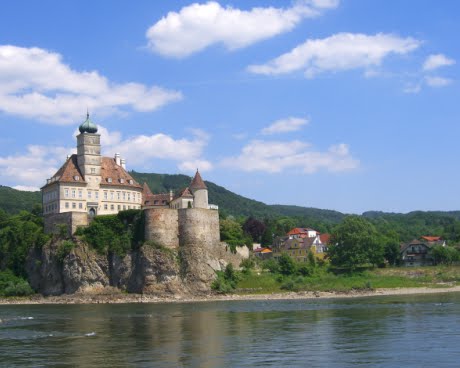

We sat on the top deck, where I got a crimson sunburned V on my chest, watching as castles and vineyards floated slowly past. One hill was said to produce 57,000 liters of wine.


About an hour down river, we disembarked at Dornstein, billed as the prettiest town in the Wachau valley.


We climbed the steep passages up to the winding main street with picturesque shop signs.


After we walked the full length to the scenic overlook, we returned more slowly, stopping in the occasional shop looking for treasures (read chocolate). This area is renowned for apricots, so everywhere we saw apricot liquors, candies, jams and juices. We stopped for apricot spritzers (soda water with a shot of apricot nectar) and sweets. Joren and I had chocolate sundaes while Keenan tried the apple strudel.


Eventually, we walked out of the old part of town to the Bahnhof, only to learn from the closed building and posted signs that the train only runs on Friday, Saturday and Sunday. Fearing that we might be stuck in Dornstein, we decided to double time it back to the boat dock, where there was one more pickup that afternoon. After getting there and checking the schedule, we realized that the time we remembered for pickup was actually the last departure time from Melk, so we just sat and waited for the boat rather than climb back up to town for less than an hour. When the time for the boat’s arrival came and went, we really started to contemplate the hotel back at the top of the hill. Fortunately, the boat was just running late, 20 minutes behind schedule, and we were able to make our way to Krems.

In Krems, we had more than a mile walk to the train station, through a thoroughly citified area. Luckily, we arrived five minutes before the train to Vienna departed. We made it back to the hotel by 9:00, tired and footsore, to grab a piece of cheese with a roll from the lounge and fall into bed.

Vienna, Day 4

Wednesday was a light day, probably because we are wearing down. We went to the Technology Museum, a combination science/technology museum and hands-on interactive kids' museum. It was amusing to see technology from my scientific lifetime enshrined in a museum. I was sad that the scanning electron microscope was out of order. Of course, I wonder if it ever was really accessible to museum patrons. The mass spectrometer was also entertaining, as it had its huge rack of electronics, with vacuum pump controllers etc. that Keenan and I both recognized. More intriguing were the cases of historical equipment from around 1900, things like old batteries and telescopes.


The most fun interactive displays were the simple physics experiments, but they were of little interest to the bus loads of children visiting that day. Too much knowledge needed to make them interesting, I fear.


A display on cast iron jewelry was intriguing. I didn't realize that cast iron was ever used for jewelry, but it was evidently popular in the late 1800s, as the initial impact of mass production on the jewelry world. This is the "casting tree," with all the pieces attached to their sprues that enable the metal to flow during the centrifugal casting process.


There was of course a display on flight, and Joren enjoyed the engines as always.

After the museum, we went back down to Stephensplatz, the huge shopping district around St. Stephen's Cathedral to find Österreichische Werkstätten, a local artist's coop featuring glass, pottery, fiber and jewlery. There I collected a black and white boat-shaped dish, with simple decorations that look very Art Deco to me. Again, it's packed up nicely to travel, so you'll have to wait to see it until we get home.


This ornate, gilded Russian Orthodox church is the view from our hotel room (over the railroad tracks). When we walked through the neighborhood near sunset the other evening, we took these photos.

Tuesday, May 24, 2011

Vienna, Day 3

On Monday, we split up at the train station. The boys headed one direction to the Museum of Military History (and then the Museum of Torture!) and I went another to the Belvedere Palace to see the Klimt paintings.


I showed the view from the gardens the night we arrived in Vienna, but here is how the front looks over the reflecting pond.


And here's the imposing front gate. The Belvedere Palace was built by Prince Eugene of Savoy. Evidently the Prince was short and not too handsome, but extremely intellectual. He was denied a military appointment by Louis XVI in his native France, but applied with the Habsburg Monarchy and rose to the top position of War Minister very quickly. The Upper Belevedere was the showplace for entertaining, while the Lower Belveder was where he actually lived during summers.


The Upper Belvedere currently houses the largest collection of Klimt paintings anywhere, including The Kiss, his most well known (see the link for larger photos). It is definitely better to see in real life, where the dimensionality of the paint and shifting colors depending on the angle of view are a vital part of the painting. One of the details I most enjoyed about some of the paintings were the frames, which Klimt designed himself and had built by his brother who was a goldsmith. They have echoing motifs and lettering. Somehow in photographs, I've found this to be totally ignorable.


The painting called Judith is a good example of the detailed frame. I also found that I had always focused on the woman and ignored the head in the lower right. The painting illustrates the Bible story of Judith, a Jewish woman who seduces the enemy commander and decapitates him. I also enjoyed his landscapes, views of a yellow palace through trees, which reminded me of the yellow of the Schoenbrunn Palace.

The Belvedere had other interesting paintings in their collection, including Monets and a Van Gogh, but the Klimts were by far the most popular. I had a quick lunch of asparagus pasta in the Palace Cafe (it's asparagus season here and I've eaten it everywhere we've gone), and decided to continue my Klimt odyssey at another museum, the Leopold, in the town center.


Another famous Klimt painting, Death and Life, hangs in the Leopold Museum, along with photos of the original painting as it was exhibited in the early 1900s, before he reworked it, adding more detail to both Life and Death and changing the background color completely.


I wasn't familiar with the faculty paintings scandal. Klimt was commissioned to make a series of paintings for the ceiling of the Great Hall at the University of Vienna. They were attacked as pornography and never installed in the building. Klimt bought them back, and during WWII they were removed to a palace in southern Austria for safekeeping, but were destroyed by a fire the day before the war ended. Only black and white photographs of them exist. The museum had full size prints of them mounted for the first time, and they are quite imposing and powerful. Above is Medicine, scandalous for its inclusion of a pregnant woman and an old woman next to a skeleton (death).


A huge collection of Egon Schiele paintings was also on exhibit (I saw more at the Belvedere), and I was quite taken with his landscapes. Most interesting were photographs from which he excerpted the building bones and his sketches displayed alongside.


Also at the Leopold was an Art Nouveau jewelry exhibit, with incredible pieces like this jeweled and enameled belt clasp and pieces by Lalique and Faberge.

When I finally met back up with the guys, we walked to a local Mediteranean restaurant through the neighborhood filled with embassies to eat antipasto, pasta and fish. Dessert was best. Joren and I ate the "chocolate parfait" which amounted to frozen chocolate mousse inside a chocolate cone, upside down on thin wafers of pineapple with passion fruit seeds. Keenan had strawberry tiramisu, all to himself as he has a cold we don't want to catch.

Monday, May 23, 2011

Vienna, Day 2

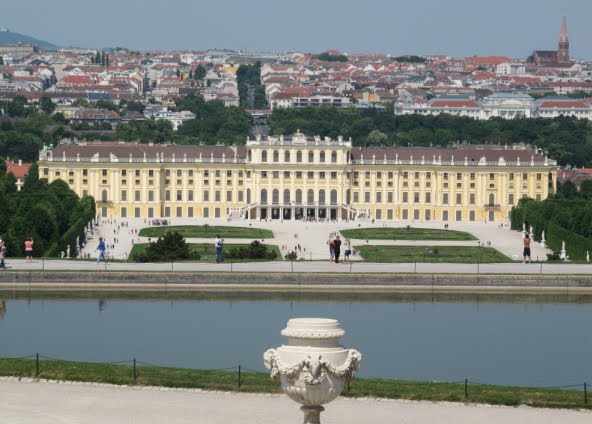
On Sunday, we boarded a busy train out to Schloss Schoenbrunn, the Imperial Summer Palace. The Palace encompasses 1400 rooms. When we debarked the train, Joren asked how far to the palace, which was just ahead. A better question was how far down to the entrance, which was a bit of a hike. This is the photo from inside the gardens, looking back at the palace proper.


Inside we bypassed the long ticket lines, having our Sisi tickets from the Hofburg. Once we gathered the prevalent audio guides, we headed into the royal apartments. Again, no photos were allowed, so I bought some postcards to substitute. First is the Round Chinese Room, with lacquered Chinese panels inset around the room, and heavy gold ornamentation forming shelves for blue and white Chinese porcelain.


Next, the Millions Room, with Indian mosaics cut apart and reassembled into new scenes and placed around the room with walnut paneling and the everpresent gilding.


Finally, the Great Gallery, only half of which we saw, as it is being restored. We were able to peak through to an area they were working on to see the worn gilt and non-glossy white enamel. They are also updating the electrical service, which was original, as in Edison installed it.


I'd say that Schoenbrunn does compete with Versailles for the most impressive palace we've seen.


The gardens are enormous, as this photo from the same place as before, but looking the opposite direction shows. In the far distance up the hill, you can see the Gloriette. Here's the fountain in the near distance.


I made it up that hill, one section at a time, keeping to the shade as much as possible, with an ice cream to cool me off (it has seemed very hot to me, although Keenan and Joren think it's pleasant here). Here's the view from the fountain back toward the palace. In the far distance, to the right, you can see the the city center.


And here's the view from the balcony at the Gloriette. Yes, I have pictures with me there to prove I made it up and back, but it's better to see the view than me.


The underside off the Gloriette roof is pretty amazing.


We ate a late lunch at a cafe on the periphery of the gardens. I had a Chef salad with ham and egg. Mixed salads here are quite different than at home. This one had greens, egg and ham, but also a cole slaw, pickled green bean salad, cucumber salad (in yogurt or sour cream), white asparagus salad in a creamy dressing, potato salad and tomatoes. The boys both ate two long sausages wrapped in bacon (!) with fries. It's a wonder they could move afterward.


Since we had a bit of afternoon remaining, we took the train downtown to Stephansplatz to see St. Stephen's Cathedral. The pictures inside are too dark to see much, and the outside photos are really too near to get a good view. Scaffolding also hides part of the facade, as the stained stone is being cleaned. Joren wanted to take the catacombs tour which was just leaving, so he and his father went down. I declined, not because the visual of bones bother me, but because I find the smell of catacombs to be annoying. No photos of the stacked bones were allowed, but just the stories were enough for me. Evidently the smell became so distressing that it deterred churchgoers from mass, so convicts had to be forced to clean and stack the bones neatly. Ick!


We skipped dinner and went to the nightly snacks at our hotel lounge (a perk for Mariott rewards members). This has been a salvation to us, as they have water available, both bottled mineral water and tap water with ice. Water is something not commonly served in Czech and Austrian restaurants, so we've bought a lot of bottled water for meals. It's never enough, since it is warm. We also have free breakfast at the lounge, which beats the 24 Euro room service breakfast. It's very nice, with eggs, bacon, sausage and potatoes, cold meats and cheeses, breads and fruit, cereal and yogurt. Joren is in love with the coffee machine, and has started begging us to reconsider plumbing one in during our upcoming kitchen remodel.